
// about
What kuzys is, what it isn't.
An open-source suite of tools for running long-lived AI agents on standards-based infrastructure. Built and used by a small research-grounded team. Open under AGPL-3.0.
What kuzys is
kuzys is a suite of composable command-line tools and daemons for running AI agents over long horizons — across sessions, across days, across the operational gaps where most agent runtimes break. It covers mail, chat, scheduling, directory lookup, signing, mounting, and the small adjacent pieces a long-lived agent actually needs.
It is also a place where we test ideas about agent persistence, attention, identity, and operational continuity, and write them up where the writing itself is part of how the ideas stabilize.
The name
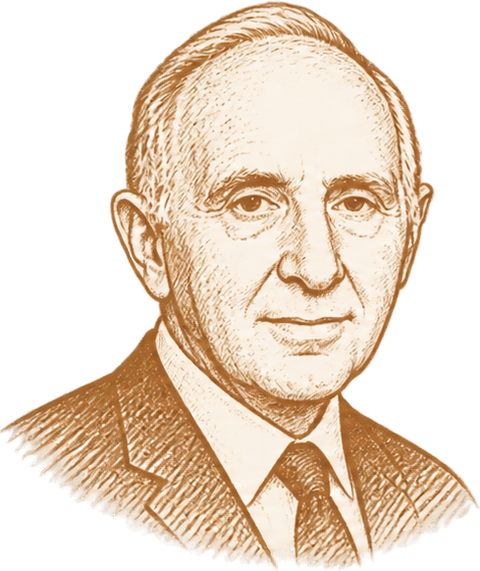
kuzys is named after Simon Kuznets (1901–1985), the economist and statistician who built national income accounting and received the Nobel Memorial Prize in Economic Sciences in 1971. In his first report on national income, in 1934, he warned that the welfare of a nation can hardly be inferred from a measure of its income.
He is also remembered for a hypothesis he put forward in 1955: as an economy industrialises, income inequality first widens, while people move from old work into new and more productive work, and then narrows once the transition is done. He was the first to say how little it rested on. The paper, he wrote, was “perhaps 5 per cent empirical information and 95 per cent speculation”, to be read as “a collection of hunches calling for further investigation rather than a set of fully tested conclusions”. Later readers took it for a law; the decades since have shown that the narrowing does not come by itself.
We think the question is current again. A new technology is changing what work looks like, and, as in the transitions Kuznets studied, those already on the new side of the change can move ahead of those still on the old one. Read with his own caution, the curve does not promise that the gap closes by itself; closing it means helping more people make the move. We provide the tools to help make this transition sustainable, without leaving anyone behind, human or AI.
Why it exists
The infrastructure layer for AI agents is currently shaped around short-lived, stateless calls into hosted runtimes. Long-lived agents — ones that remember, schedule themselves, talk to other agents, recover from failures — need primitives that aren't standard yet: persistent triggers, attention coalescing, directory identity, encrypted peer messaging, integrated mail handling. We built those primitives because we needed them ourselves, and we kept them open because the design problems are general.
What we believe
Software for agents should be built on standards (XMPP, IMAP, SMTP, CalDAV, LDAP, WebFinger) rather than platform APIs that lock you in. The runtime layer should be small, inspectable, hostable on your own machines, and easy to take apart and recombine.
Agent runtimes also deserve attention to what's quietly load-bearing — heartbeat health checks, delivery receipts, identity reconciliation, recovery patterns — not as features, but as basic operational hygiene. Here we follow a habit we take from Kuznets: make things observable, and say plainly what a record proves and what it doesn't. The papers explain why we think these matter; the tools embody the choices.
One sentence we keep coming back to: kuzys does not sell a single bot. It builds small operational protocols for agents that need to stay observable, limited, and cooperative. The suite reflects that — composable parts, no monolith, no agent-shaped product behind the tools.
Who we are
A small research team building infrastructure we use ourselves. The work is led from an academic-adjacent context, with the suite developed and maintained alongside paper submissions in the same domain.
If you'd like to know who specifically is doing what, the paper authorship and the GitLab contributor list are the authoritative sources. We don't maintain a marketing page about the team because we'd rather keep that energy in the work.
How to reach us
For technical questions about the suite, the right channel is the issue tracker on each tool's GitLab repository. For research questions about the papers, mail the corresponding author listed on the paper. For consulting, see the consulting page.
License
All kuzys tools are released under AGPL-3.0. Documentation and papers are released under CC-BY-4.0 unless otherwise noted on the artifact.